Best Whole Grains for Milling: How to Make Freshly Ground Flour at Home

In recent years, more and more people have begun to question the quality of highly processed foods found on grocery store shelves. Food labels have become a list of mystery ingredients we can’t pronounce, while nutrients have been stripped away for the sake of shelf life. It’s no surprise that many are turning back to unprocessed, REAL food. Whole grains are at the heart of the movement! When you mill your own grains at home, it’s like picking a fresh apple straight from the tree; you’ll enjoy the most flavorful and nutritious flour possible! However, as you begin to learn about whole grains, the choices can be overwhelming! It all starts with choosing the best grains for milling to produce flour that’s fresh, flavorful, and full of nutrients.
What are whole grains?
Whole grains, as defined by the Whole Grains Council in 2004.
“Whole grains or foods made from them contain all the essential parts and naturally-occurring nutrients of the entire grain seed in their original proportions. If the grain has been processed (e.g., cracked, crushed, rolled, extruded, and/or cooked), the food product should deliver the same rich balance of nutrients that are found in the original grain seed.”
Source wholegrainscouncil.org

A Multitude of Options
Whole grains include a multitude of grains; however, not all are appropriate for milling.
Per the definition of the National Whole Grains Council, any product labeled as “whole grain” must be made with whole grains to include all parts of the grain: the bran, germ, and endosperm. Store-bought flour has been stripped of the bran and germ to make commercial white flour, which, unfortunately, also strips away most of its nutritional value. You can buy whole wheat flour that has already been ground, but it begins to oxidize and loses almost all of its nutritional value within just 3 days after milling.
As an aspiring baker interested in milling flour for the health benefits of using your own flour at the peak of freshness and nutrition, this post will sort through the most common grains you might consider as a home baker.

Looking for resourcES?
Everything you need to know to get started using fresh ground flour!
Don’t know where to start?This page is dedicated to helping you navigate the resources available to get you started on your fresh ground flour baking journey.
What are Wheat Berries?
Wheat berries are the edible portion of the wheat kernel. Wheat kernels contain three parts: the bran, the wheat germ, and the endosperm. The bran is the hard, outside layer. This is nutrient-rich and full of dietary fiber. Another part of the wheat berry is the germ. It is full of nutrients and oil. Lastly, there is the endosperm, which is primarily starch. For my fellow science nerds, this is an image of the anatomy of a wheat berry with a breakdown of its nutrients.
Wheat berries include a wide variety of wheats.
Terms like modern wheat, ancient grains, or heritage grains add to the confusion in selecting grains to mill.
Modern Wheat:
Modern wheat refers to wheat varieties that have been cross-bred for modern commercial agricultural practices. Contrary to popular belief, there is no genetically modified (GMO) wheat grown in the United States. However, through genetic selection or common breeding practices, modern wheat has been bred to produce higher yields, be more disease resistant, and more resistant to the elements. Modern wheat is shorter than its ancient counterparts; however, it’s also less weed-resistant, making modern commercial farmers more reliant on chemical weed control.
Ancient Grains:
Ancient grains are grains that have largely remained unchanged for thousands of years. Ancient grains have distinctive flavor profiles, making them a great option for those looking to take their baking to a new level. Ancient grains are more resilient to organic farming practices.
Heritage Grains:
Heritage grains refer to a variety of whole grains that have some adaptations from their ancient grain counterparts. However, they have not been subjected to the intensive cross-breeding of modern hybrid wheat. Heritage grains include not only wheat but rye, barley, and oats.
How to Choose?
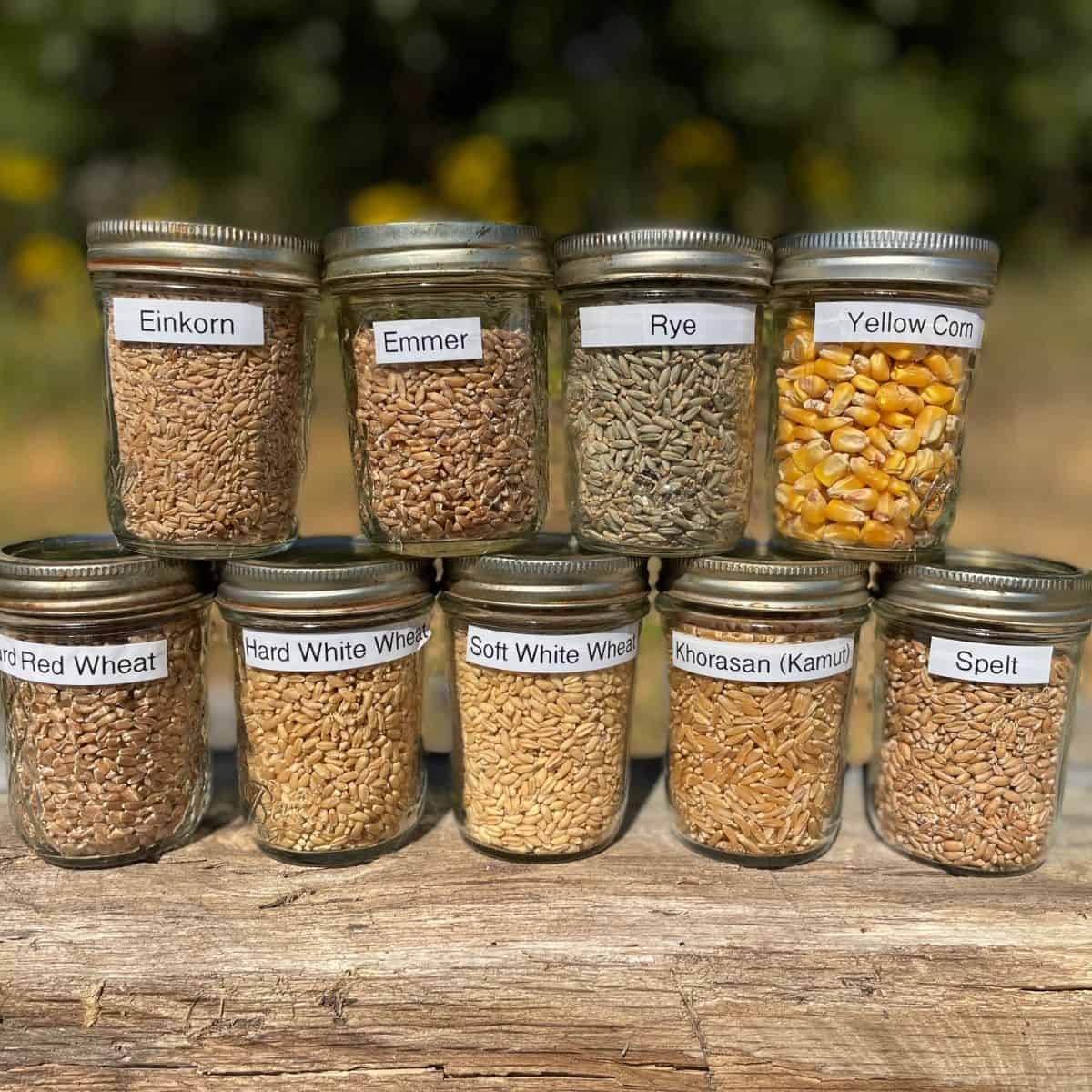
When you begin using whole grain flour, the different types of wheat can be confusing. Every baker looking to replace commercial flour should start with the two basic grains.
Hard Wheat
For the baker looking to bake bread, hard wheat berries are higher in protein and have a higher gluten content. Gluten gets a bad rap in today’s society, but gluten is a good thing! Gluten is what allows bread to stretch, making homemade bread rise. Hard wheat berries come in hard white wheat berries or hard red wheat. Hard white wheat will be milder in flavor, while hard red wheat will have a bold, whole grain flavor. The two grains are similar nutritionally, with hard red wheat having a slightly higher percentage of protein. Both are good sources of fiber.

For those new to whole grains, I recommend hard white wheat as a starter grain for all aspiring bakers who want to bake yeast breads that rise. For generations, we have been removed from the flavor of whole grains. We’re accustomed to bland, fine flour that is void of texture and the rich flavor of whole wheat berries. Making the switch from all-purpose flour to freshly milled flours will be a flavor adjustment, regardless of the grain you choose. In my experience, hard red wheat creates a very bold whole wheat bread with a strong rustic flavor; therefore, I recommend starting with hard white wheat to make that transition a bit more gradual. I also like mixing hard white and hard red in my breads to incorporate both varieties.
Soft Wheat
Soft wheat also comes in both red soft wheat and white soft wheat. It has a lower protein content, making it ideal for baked goods that have a softer, fluffier, more tender texture and crumb. This type of wheat is the best choice of wheat berries to make baked goods that don’t rise, such as quick breads, cookies, cakes, and pie crusts. Soft wheat berries tend to mill finer during the milling process, which comes from a softer texture of the endosperm. Soft white wheat has a mild flavor and it perfect in most baked goods. Soft white wheat is the second wheat berry that I recommend to all aspiring fresh-milled bakers.

Find this post helpful?
Share it on Pinterest
Must Try Ancient Grains
Once you have made the switch from all-purpose flour to fresh flour by experimenting with hard and soft wheat varieties, the next step is to embrace the flavor and richness of ancient grains. In my opinion, other than nutrition, the variety that fresh milled flour adds to your baking is one of the best parts of embracing these healthy grains.
Khorasan
Khorasan, commonly referred to as Kamut is one of the first ancient grains I experimented with. Kamut, meaning “wheat” in ancient Egyptian language, is the trademarked name of Khorasan wheat. Kamut was trademarked by Bob Quinn not as an effort to protect his work, but to protect this ancient grain from modern hybridization. Any wheat sold under the trademark Kamut, must meet 7 standards of excellence.
Khorason wheat is a large kernel of wheat with a golden color that makes it distinctive. It has a buttery flavor and performs well in yeast breads. While you can bake with 100% khorasan wheat, I prefer to mix it with hard white wheat to improve the gluten structure to help the bread rise better when used in yeast breads. Khorosan wheat is my favorite grain to use for cream of wheat!

Spelt
Spelt is one of my favorite ancient grains! I love the nutty flavor that spelt brings to baked goods. It’s amazing in cookies, bringing a nutty flavor without adding nuts, appeasing all members of our household, both those who prefer nuts and those who don’t. Spelt, like some other ancient grains, has a tough outer hull that requires extra processing to remove. Since modern wheat could be processed in a single step with modern commercial machinery, grains like spelt all but disappeared in the American diet. It wasn’t until 1987 that spelt was reintroduced in the United States.
Another favorite way to use spelt is to make waffles. I mix spelt and soft white wheat to make a rich, flavorful waffle. Ancient grains are more expensive than modern grains; mixing them with more cost-efficient wheat berries allows the flour to go further; however, the distinct flavors they bring to the baked goods still shine through.
Try mixing different ratios of flour or different grains to create unique flavors. However, when using these flavorful grains, be mindful of the flavor you expect in the finished baked goods. I once used spelt to make snickerdoodles, and the fresh-milled flour changed the flavor of the snickerdoodles enough that I was disappointed in the final product.

Einkorn
Einkorn has become extremely popular in the last few years, almost trendy. It, along with emmer, is considered the original wheat, dating back thousands of years. Einkorn is a primitive wheat, containing only 14 chromosomes, while modern wheat contains 42. This chromosomal difference seems to be connected to the digestibility of einkorn. Many who struggle with wheat sensitivities can eat einkorn without the stomach upset of other forms of wheat. Einkorn is a hulled wheat, called farro piccolo. Like spelt (farro grande) and emmer (farro medio) it is a hulled wheat that requires extra processing to remove the outer hull.
Einkorn is described as having a sweet, slightly nutty flavor. I have found it takes some finesse to bake with einkorn. While it is high in protein, it lacks the gluten structure of modern wheats and creates dense bread. While einkorn has less gluten, it is not a gluten-free product, though many with gluten sensitivities find it easy to digest.
Einkorn is wonderful in quick breads and is a favorite in pancakes.
Want to learn more about nutrition? This Grain Nutrition Comparison Matrix is an excellent resource.
Emmer
Emmer is a new grain to me. Like einkorn, it is considered one of the original wheats. In Italy, emmer is called farro. Some emmer is pearled in the hulling process; during the process of hulling, parts of the grain are removed. Pearled emmer would not meet the definition of a whole grain product. For the sake of milling my own grains, I am using whole emmer that has not been pearled.

Emmer is often eaten as a whole grain in soups or risotto. In Italy, it is quite popular and is available in supermarkets and bakeries. Emmer is said to have a robust flavor. It gained popularity over einkorn because it’s an easy grain to grow. It creates a soft flour that has a reddish tint.
Like other ancient grains, emmer is best when mixed with hard wheat for yeast breads to improve the gluten structure.
Rye
Rye is a grain that most people have a love or hate relationship with. I originally purchased rye to feed my sourdough starter. Rye helps sourdough starter convert sugars to jumpstart fermentation. While rye has a distinct earthy flavor, the powerful flavor in rye bread is the caraway seeds rather than the rye itself. Rye is a green grain that has a greenish-blue tint to it, making it distinctive to mill. My very first experience baking with rye was in brownies. I was pleasantly surprised by how delicious they were. There were no rustic or odd flavors mingling with the chocolate. Later that week, I added rye to my pizza dough. The dough has a more distinctive color to it, but the flavor was good, and the pizza baked up beautifully. Rye is especially popular in Europe, often eaten as cereal.

Durum
Durum wheat is a hard wheat grown primarily to produce pasta. Duram is a very hard wheat, and it is typically milled into semolina that is used to make pasta. Semolina is a coarse grain, though durum can be milled into a fine flour. Pasta making is on my list of projects to try.
Corn
One of the best things about having your own mill is being able to experiment with different types of whole grains. While I don’t bake with a lot of corn, I do keep a supply of dent corn on hand for cornbread. My Nutrimill Harvest Stone mill grinds corn to a beautiful texture, but be aware that corn is not appropriate for all home grain mills. Be sure to check your owner’s manual for your electric grainelectric mill prior to milling corn. It’s also important to note that popcorn is different than dent corn that is commonly milled for cornbread. Unlike wheat, which is not genetically modified in the US, corn is highly modified. Be mindful of your grain source when ordering, if organic corn is important to you.
Other Options
There are many other grains appropriate for milling. If you have special dietary needs, you can choose from gluten-free grains and legumes. Most grain mills can mill all non-oily grains, but I encourage you to follow the guidelines for grains appropriate for your specific grain mill.
Learn More About Milling Grains Here


Embracing Whole Grains
As a young mom, I always had the best intentions to feed my kids the most nutritious homemade meals. I was angry to learn that the store-bought flour I had been buying for decades was highly lacking in nutrients, making my efforts seem in vain. But when you know better, you do better! Baking with fresh milled flour can be challenging, and it may be a difficult texture and flavor transition for your family. Baked goods made with whole grains will be different than the ultra-processed foods they may be accustomed to. I encourage you to push through! It may mean mixing your whole grains with all-purpose flour to win them over. Be persistent! Knowing that you are baking with the most nutrient-dense flour you can gives peace of mind, and it’s worth the effort!

About the Author: Barbra-Sue Kowalski grew up on a small hobby farm. She was always drawn to farm life, however, she was stuck in an urban life far from her roots. Barbra-Sue was a single mom for 13 years, raising her 3 children on her own. She met Philip in 2018 and they married in 2021. Between the two of them, they have 5 grown children and 6 grandchildren. These empty nesters are following their dreams! As they both turn 50, they are building their off-grid homestead to live the life that they dream about. Learn more about Philip and Barbra-Sue here. Contact them here. To leave a comment on this post, please scroll down.